Games inside the game

Scrabble

Not a minigame with the word "scrabble" in it — an actual game of Scrabble. A 15×15 board, 100 tiles in the standard English distribution, the full premium-square map, correct Scrabble scoring, and the fifty-point bonus for laying down all seven of your tiles in one turn. It is played entirely through MUD commands, and the board is drawn to you in colour.

What it looks like

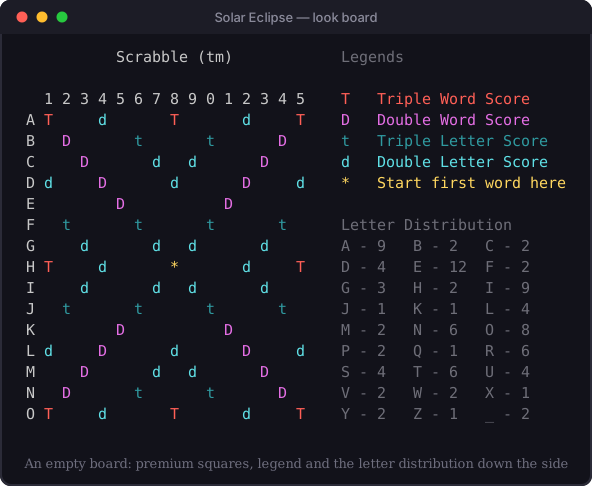
Drop the board and the bag on the ground and look at the board. Fifteen rows lettered A–O, fifteen columns numbered 1–15 (the header runs 1234567890 12345, which is the tens digit dropped), the legend down the right and the letter distribution below it.

An empty Scrabble board as the game draws it, with premium squares, a legend
                  and the letter distribution

A board with nothing on it

What you see when a set is first put down

The premium squares carry their own colours: T triple word, D double word, t triple letter, d double letter, and * the centre star at H8, where the first word of the game has to cross.

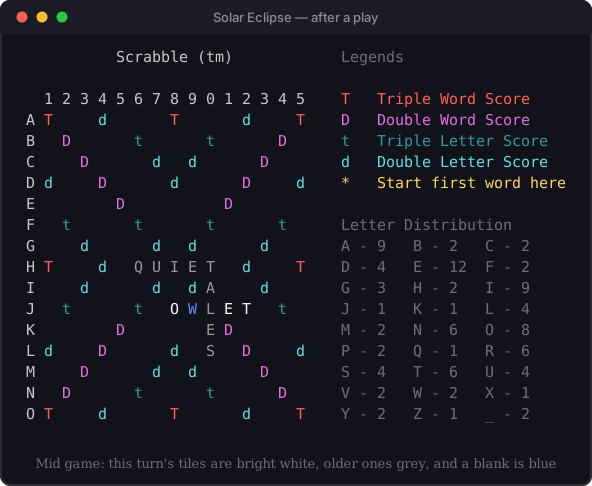
A Scrabble board mid-game, with QUIET, TALES and OWLET played and the newest
                  word highlighted

A game in progress

QUIET opened over the star, TALES hangs off its T, OWLET has just landed

The colours are doing three jobs. Tiles played this turn are bright white and everything older is grey — which is why the L in the middle of OWLET stays grey: it was already down as part of TALES, and OWLET only borrowed it. A blank is blue, and the W of OWLET is one, played as a W and stuck as a W for the rest of the game.

Reproduced from the server's own board renderer rather than photographed from a session, so the colours and spacing are exactly what the game sends. Your client's palette will differ.

Getting a set, and playing

Before anything else

A set costs 100 quest points from the questman. You are handed two things, a board and a bag, with all hundred tiles already inside the bag. Then put both on the ground — every command here looks for the board and the bag in the room you are standing in, not in your inventory, so a set still in your pack may as well not exist.

place <row> <col> <horizontal|vertical> <word>

Lay tiles on the board. Rows are the letters A to O, columns the numbers 1 to 15, and the direction abbreviates — place H 6 h quiet is the opening word on the board above. A space means skip this square, which is how you build on a letter already down: if there is an A sitting at J4 and you want to make CAT out of it, you play place J 3 h c t — C, skip, T. Naming the A yourself just gets you told the square is occupied, and you must own a tile for every letter you do play.

drawtiles

Fill your rack back up to seven from the bag, one tile at a time.

checktiles

Look at what you are holding, with each tile's point value under it.

showtiles

Show your rack to everybody in the room. For the honest, or the doomed.

tradetiles <letters>

Put tiles back in the bag and draw replacements.

cancelplay

Take back the tiles you played last turn. The board goes back to how it was, premium squares included.

settile blank <letter>

Decide what a blank is going to be. settile blank q makes it a Q. With two blanks in hand, settile 2.blank q picks the second. Once played it stays that letter for the rest of the game.

The rules it actually enforces

This is real Scrabble, not an approximation of it, and the awkward rules are the ones it gets right.

The first word crosses the star

The opening word of the game must lay a tile on the centre square at H8, and the star is not just a starting mark: it counts as a double word square for the word that lands on it, so the first play is worth twice what it looks. After that, every play has to touch what is already down — at least one of your tiles must sit next to an existing one, and every square you skip over has to actually have a tile in it.

A premium scores once, ever

Double and triple squares count on the turn a tile lands on them and never again, so a word built later across a triple gets nothing for it. It is also why your last play shows bright white on the board while everything older is grey.

All seven is worth fifty

Lay down every tile in your rack in one turn and you get the standard fifty-point bonus on top of the words themselves. The tile distribution is the real one too: A×9, E×12, one each of J, K, Q, X and Z, two blanks, a hundred tiles — and the scores that go with them, one point up to Q and Z at ten, a blank at nothing.

It checks your spelling — and lets you play it anyway

The game holds a full Scrabble word list, and every word you make is looked up. Play something it does not know and your score line comes back tagged (iffy spelling) — but the word stays on the board and the points are still yours. It tells the room what it thinks of your spelling and leaves the arguing to you.

A blank is a commitment

You name a blank's letter before you play it and it holds that letter for the rest of the game. It shows blue on the board so everyone can see what it really is, and it scores zero no matter what it is standing in for.