Games inside the game
Chess
Not a puzzle and not a minigame — chess, with every rule in it. Castling, en passant, promotion, stalemate, the fifty-move rule, threefold repetition, too little material left to mate with, and checkmate. You play it on a board you can pick up and carry, against another player or against somebody who lives here.
What a board looks like
Ten lines: the eight ranks, with the file letters above and below them. The squares meet, so it reads as one board rather than sixty-four boxes, and each one is three columns wide because a terminal character is about twice as tall as it is broad.
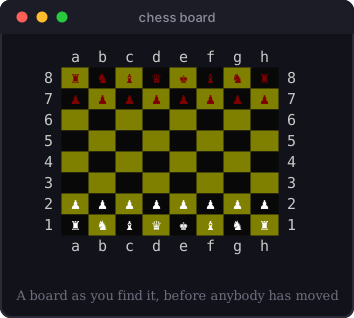
Before anybody has moved
Thirty-two pieces, and the eight ranks between the letters
A game, a few moves in
Moves are written on their own, in ordinary notation: e4, Nf3,
0-0, e8=Q. Nothing else is needed — the game works out
which piece you mean, and says so if two of them could go there.
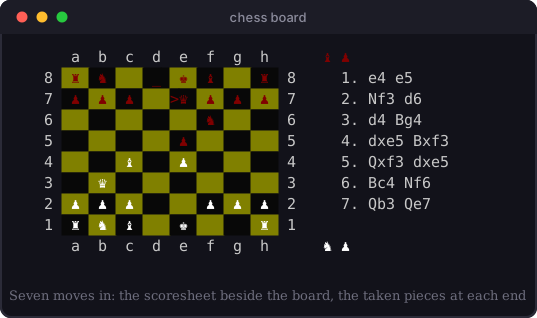
Seven moves in
The scoresheet reads down the side, like a scoresheet on paper
Two things sit around the board without being asked for. The moves so far run down the right, newest last. And what each side has lost is gathered at the end the pieces came from — your losses below the board, your opponent's above — heaviest first.
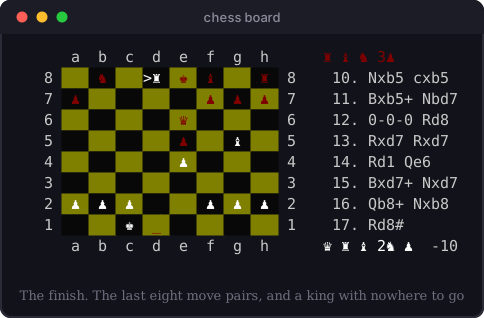
And how it ended
Seventeen moves, and the last one is Rd8#
Eight move pairs fit beside the board, so a longer game scrolls and the move just played is always on the bottom line. The number at the corner is the material difference — −10 here, which is the point: this side gave away a queen, a rook, a bishop and two knights and still finished it.
The two squares that just changed
Every board marks the move that was played. A > appears beside the square
a piece arrived on and a _ on the square it left, and in a live client both
blink. It is the difference between reading a board and seeing what happened on it.
Your own side of the table
A board is drawn from where you are sitting. Playing black, your pieces are at the bottom and the files run the other way — the way you would turn a real board round to face you.
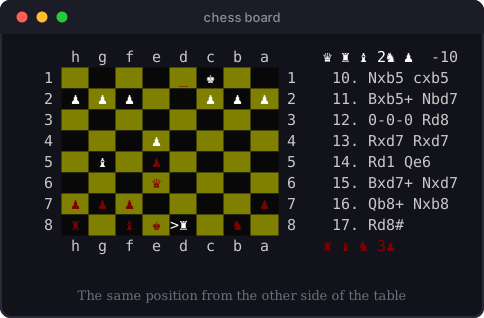
The same position, sitting opposite
Black at the bottom, and the letters running h to a
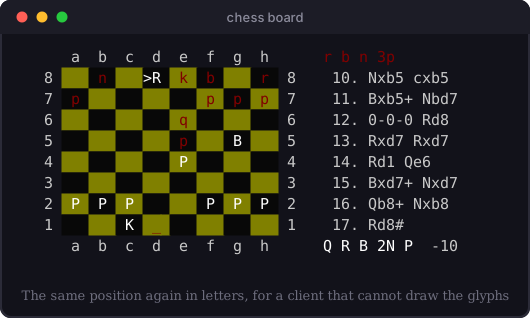
Or in plain letters
Capitals are white, lower case is black
Boards come with their pieces drawn as glyphs or as letters, and a client that cannot manage the glyphs is quietly given the letters instead. Case carries the side either way, so the board still reads with colour switched off entirely.
Finding somebody to play
You need a board
Chess is played on a board that exists as an object in the world, so the first thing a game needs is somebody holding one. Solar Eclipse's very first board is still lying about somewhere, there is a heavy marble one in New Thalos, and they are not the only two. Whoever holds the board is the one who offers the game.
chess challenge <who>
Offer a game to a player, or to somebody who lives here.
chess accept / chess decline
Answer one.
chess board
Draw it again, when the screen has scrolled away from it.
chess moves
The whole game so far, not only the last eight pairs.
chess draw
Offer a draw, or take one that has been offered. It stands until you move again.
chess resign yes
Concede. The yes is deliberate.
The other kind of opponent already lives here, and you do not have to leave the starting ring to find one. A dozen or so of the people you already walk past in Solaris will sit down to a game: the bartender in the Grunting Boar, Melancholy at the map shop, the wizard in the magic shop, the mayor in his own office, the teller at the bank — and a walrus. None of them are any good, which is rather the point. They are somewhere to learn on.
After that they are scattered, and they get harder the further out you go. Well over a hundred of them are spread across ninety-odd areas, from an innkeeper who will give you a friendly game to an elder monk, a starship captain, a guru at the end of time and somebody sitting alone in the middle of a temple. The weakest look one move ahead and blunder about two times in five. The strong ones look five moves ahead, play their openings out of a book, and do not blunder at all.
And then there is one who is better than any of them, somewhere, at the very top of the range. It looks six moves ahead and takes twice as long about it — and it is the only opponent in the world that talks to you across the board. Not every move, which would be unbearable: when you take something, when you give check, and every so often in between, it has a remark to make about the game you are both looking at.
There is no list of them, and there is no badge. Ask somebody who does not play and they will look at you blankly, which is its own way of answering — so the only way to find the good ones is to carry a board and keep asking.