Games inside the game
Xiangqi
Chinese chess, and a second game rather than a variant of the first one. Two armies of sixteen on nine files and ten ranks, standing on the crossings rather than in the squares, with a river across the middle and a walled palace at each end that the general never leaves. Every rule is enforced — the horse's leg, the elephant's eye, the cannon's screen and the flying general among them.
What a board looks like
Twenty-one lines: the ten ranks, a row of grid between each pair of them, and the file letters above and below. The lines are drawn because they have to be — pieces stand on intersections, and without the grid there is nothing to say that two chariots on one file are on the same line.
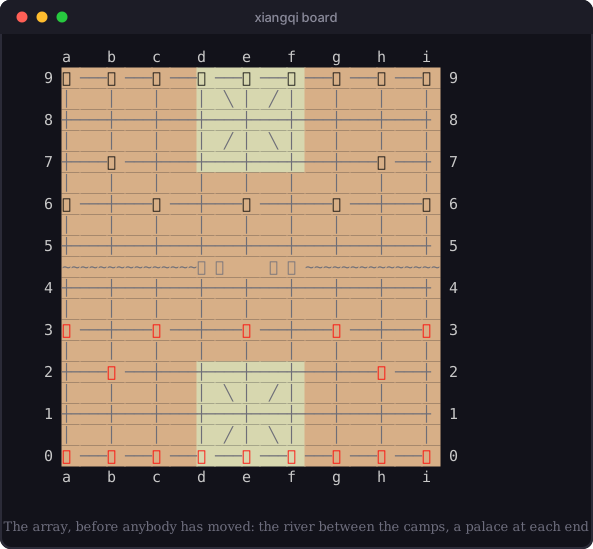
Before anybody has moved
Thirty-two pieces, two palaces, and the river between the camps
The pale ground is not decoration. Both armies stand on one colour, so unlike a chessboard it cannot balance a light army against a dark one — the ground has to contrast with red and black at once, which is also how a real set looks: dark characters on pale wood.
楚河 · 漢界
The band across the middle is the river, and it carries the inscription a real board carries: the Chu river and the Han border, the two states whose war the game is a picture of. Every file line stops at the water, the board's own edges included, which is what makes the two halves read as two camps. The gap is paint rather than a wall — a chariot moves straight through it.
A game, a few moves in
Moves are typed on their own, with no command in front. The notation is
WXF — four characters: a piece, a file, an action
(+ advance, − retreat, . traverse) and a
value. C2.5 plants a cannon on the centre file; H2+3 brings a
horse out. Coordinates work too, if that is what you have: h2e2 is the same
move as C2.5.
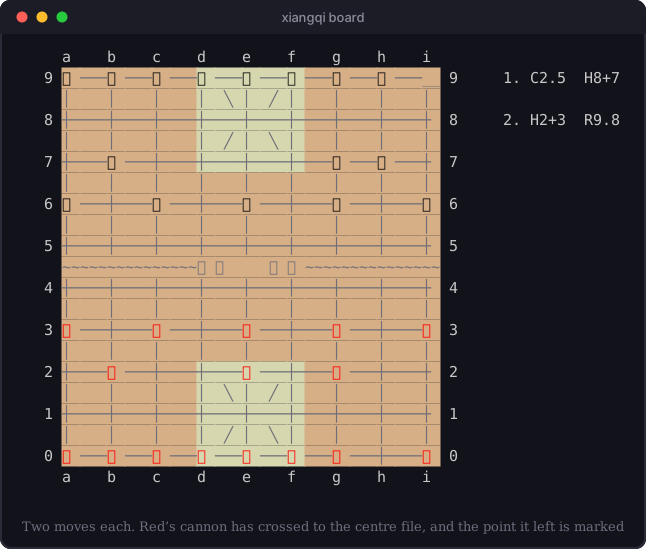
Two moves each
The central cannon, and the point it came from still marked
C2.5 — 炮二平五 — is the first move every xiangqi player
learns, and the file numbers are why it is worth spelling out. They are counted from
the mover's own right, so the same physical move is written two
different ways depending on whose it is. Get the mirroring wrong and this move comes
out as C8.5.
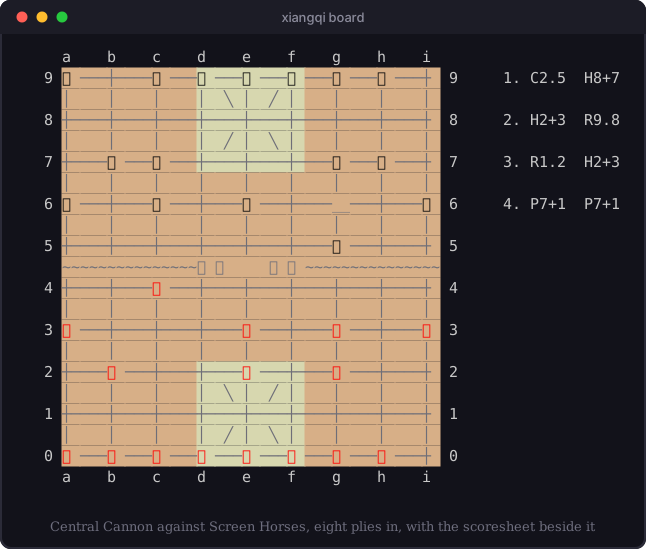
Four moves each
Central Cannon against Screen Horses, and the scoresheet beside it
The most played opening there is. Red plants a cannon on the centre file and black answers by bringing both horses in front of the elephants to screen it. The moves so far run down the right, newest last, written against the rank rows only — a move on every line would double the column's length and tell you nothing more.
The two points that just changed
Every board marks the move that was played: the point a piece left carries a
_, and in a live client both it and the piece that arrived blink. Chess's
boards use an arrow beside the square instead — here that would cost a column the
grid needs for its own line.
Your own end of the board
A board is drawn from where you are sitting. Playing black, your army is at the bottom and the files run the other way — the way you would turn a real board round to face you.
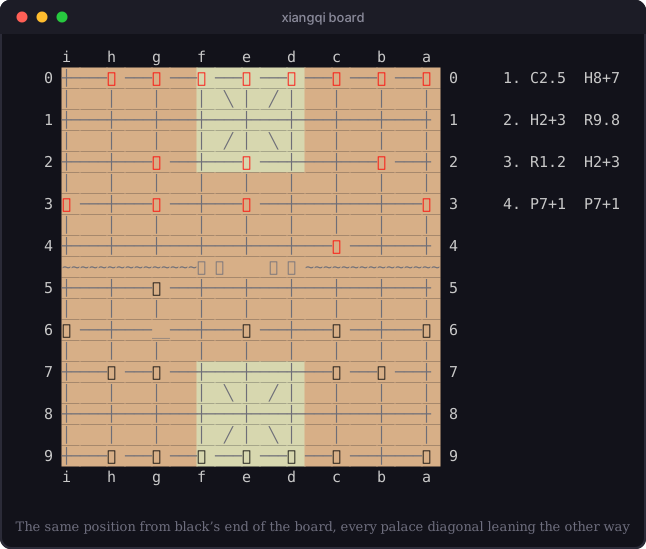
The same position, sitting opposite
Black at the bottom, and the letters running i to a
Look at the palaces. Every diagonal leans the other way, and there is no second table anywhere that says so — which way a slope falls is worked out from what is printed above it on the screen, so turning the board round turns the slopes with it for free.
Or in plain letters
The characters above are what a client that has negotiated UTF-8 is sent, and they are
what the game is played with. A client that has not gets the same board in letters
— K A E H R C P for red and lower case for black. Those are the
notation's letters rather than a FEN's, so an H you read off the
board is the H you type in H2+3.
There are two sets and not three, and the reason is width: a Chinese character is two terminal columns everywhere it renders at all. It earns them — five of the seven pieces are written differently for the two sides, so the board carries which army a piece belongs to in the glyph itself and stays readable with colour switched off.
The rules that are not chess's
The two games look alike from a distance and are not alike anywhere it matters. These are the differences you will actually walk into.
The cannon needs something to jump
A cannon moves like a chariot but captures only over a screen: exactly one piece between it and what it is taking, and any piece will do, including one of its own. It is the piece that makes xiangqi sharp, and the reason the game stays tactical long after a chess position would have settled.
The horse has a leg
A horse steps one point orthogonally and then one diagonally, and a piece sitting on that first point blocks it. There is no jumping. A horse can be shut down by its own army crowding it, and in the opening it regularly is.
The elephant has an eye, and cannot cross
Two points diagonally, blocked by anything on the midpoint, and it never crosses the river. An elephant is a defender for its whole life and can never attack the enemy general.
The generals may not see each other
Two generals facing down an open file is illegal — and not only for the general that steps onto it. Moving any piece out from between them is illegal too, which is the half that catches people out.
No legal move is a loss
The one place xiangqi inverts chess. A player with no legal move has lost, in check or not. There is no stalemate to save you, and a soldier on the last rank with a piece either side of it is a real way to run out.
A soldier never promotes
It moves one point forward and cannot retreat. Cross the river and it gains a sideways step — and that is all it will ever gain. It is nearly inert before the crossing and one of the pieces that finishes games after it.
Two more, quietly: a repeated position is a draw on its third occurrence, whoever caused it. Under tournament rules perpetual checking or chasing is a loss and the rules for deciding whose fault it was run to pages; a mud has nobody to arbitrate, so this takes the simpler line and says so. And the sixty-move rule is the Asian figure — sixty moves each — counting captures alone, because a soldier's push is not the sign of progress a pawn's is.
Finding somebody to play
You need a board
Xiangqi is played on a board that exists as an object in the world, and whoever is holding it is the one who offers the game. Red moves first, and which of you takes red is tossed for.
xiangqi challenge <who>
Offer a game to a player, or to somebody who lives here.
xiangqi accept / xiangqi decline
Answer one.
xiangqi board
Draw it again, when the screen has scrolled away from it.
xiangqi moves
The whole game so far, not only the pairs beside the board.
xiangqi draw
Offer a draw, or take one that has been offered.
xiangqi resign yes
Concede. The yes is deliberate.
The engine behind an opponent runs the same ladder chess's does — eleven strengths, from one that looks a single move ahead and blunders about twice in five to one that searches five deep and does not blunder at all. It counts material the game's own way rather than chess's: chariot nine, cannon four and a half, horse four, advisor and elephant two apiece, and a soldier worth one until it crosses the river and two afterwards. That last term is the difference between an engine that understands xiangqi and one that trades a crossed soldier for an uncrossed one all afternoon.
There is no opening book, where chess has one, so every level improvises from the first move.
Who actually plays
A hundred and two of them, across fifty-nine areas — and they are a different crowd from chess's. Xiangqi here is the worldly game, so the people who play it are scholars, diplomats, merchants, tradesmen and the rich: librarians, astronomers and cartographers, a sultan, a handful of bankers, the grocer, the blacksmith, the mayor. Aristotle, Socrates and Plato all play, and all three are strong. So do the master monks and their emeritus.
They get harder the further out you go. A tradesman in a market town looks a move ahead and blunders freely; a librarian two hundred levels deep searches four and does not. The ladder runs from one to nine here — nobody is set to ten yet, because there is no signature opponent the way chess has one.
Every one of them stands still and none of them are hostile, which is not a coincidence: a game needs somebody who will still be there for the second move. Ask anybody else and they will look at you blankly, which is the game's own way of saying no.
The scarce thing is the board. There is one in the world so far, in Solaris — the grocer in the General Store keeps it — and it is not yet something a shop will sell you.